
The first few weeks of school can tell parents a lot.
The backpacks are packed, new routines have started, and the excitement of the first day has passed. Now many parents begin asking a different question:
How is my child really adjusting?
For children with autism and other developmental needs, a new school year can reveal strengths and challenges that may not have been as noticeable during the summer.
New teachers, classroom routines, peer interactions, transitions, communication demands, and increased expectations for independence can all require adjustment.
Some children settle into these changes with time. For others, challenges may continue or become more noticeable.
At RCG Behavioral Health Network, we encourage families to look beyond what is difficult and consider what a child may be communicating and what skills could help them succeed.
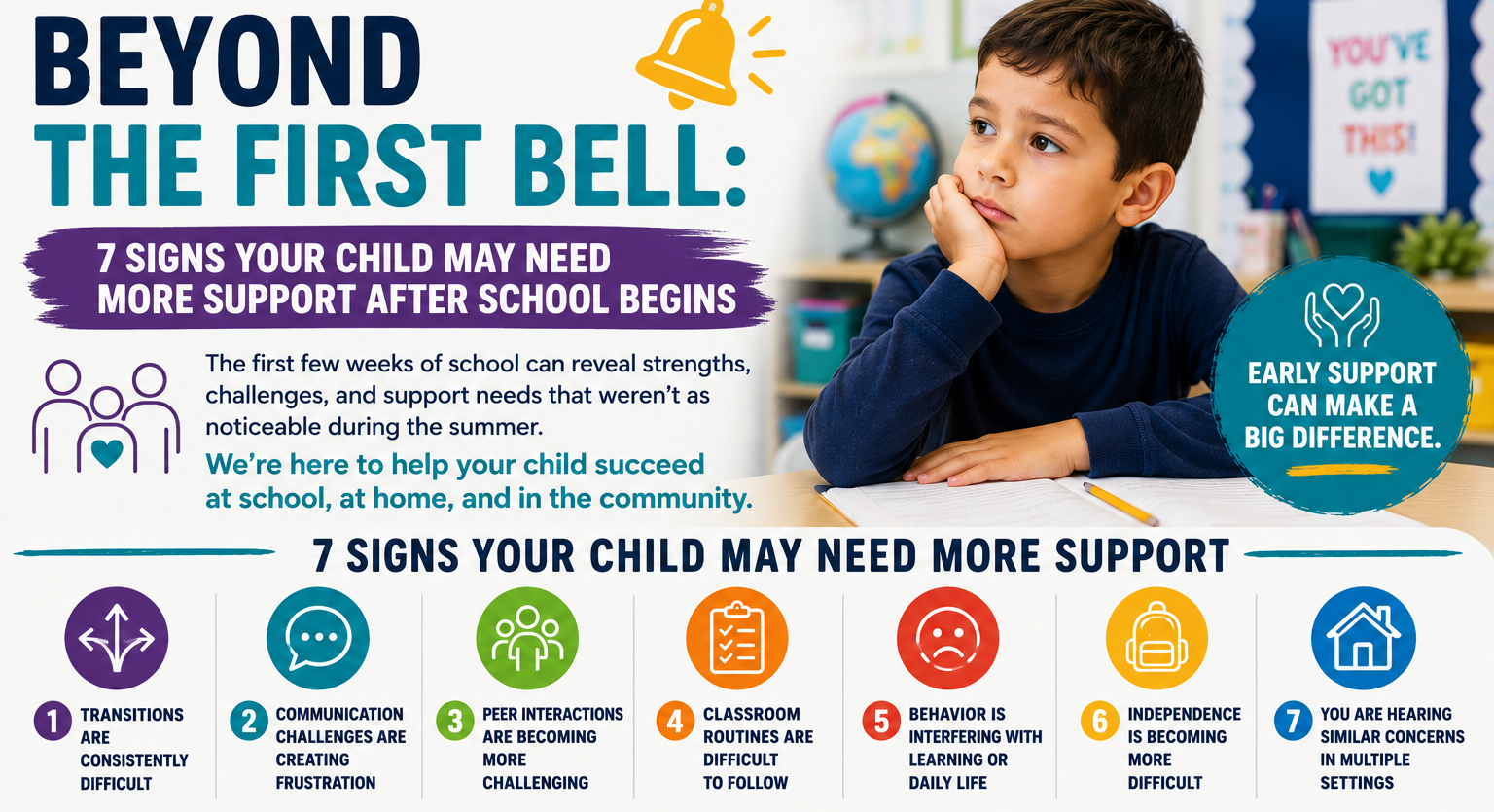
If you have noticed changes since school started, here are seven signs it may be helpful to explore additional support.
1. Transitions Are Consistently Difficult
Think about how many transitions happen during a typical school day. Children move from home to school, one classroom activity to another, preferred activities to less-preferred activities, lunch back to learning, and eventually school back to home.
Unexpected changes such as substitute teachers, assemblies, schedule changes, or special events can add another layer of difficulty.
Occasional difficulty with transitions is not necessarily cause for concern. However, when transitions consistently interfere with a child's ability to participate in school or everyday activities, additional support may be helpful.
Depending on a child's individualized needs, ABA therapy may help develop skills such as:
- Following visual schedules
- Moving between activities
- Waiting appropriately
- Tolerating changes in routine
- Requesting additional time
- Requesting a break
- Understanding First-Then expectations
- Building flexibility
The goal is not simply getting a child to follow directions. It is helping them develop meaningful skills that can make transitions more predictable and manageable.
2. Communication Challenges Are Creating Frustration
Children need to communicate throughout the school day. They may need to ask for help, say they do not understand, request a break, express a preference, ask to play, or communicate that they are finished.
Communication does not always mean spoken language. Depending on the child's individual needs, communication may include words, gestures, pictures, signs, or Augmentative and Alternative Communication (AAC) devices.
When a child does not have an effective way to communicate a need, frustration may increase and behavior may become another way of communicating.
ABA therapy can support the development of functional communication skills based on a child's individual needs. When appropriate, ABA professionals may also collaborate with speech-language pathologists and other members of the child's care team.
The goal is meaningful communication that children can use in everyday life.
3. Peer Interactions Are Becoming More Challenging
School creates many opportunities for social interaction. Children may be asked to share materials, wait their turn, join a group, respond to classmates, participate in activities, navigate disagreements, and understand personal space.
Some children benefit from more direct instruction and opportunities to practice these skills.
Depending on individual needs, social goals may include:
- Initiating and responding to interactions
- Taking turns and sharing
- Participating in group activities
- Recognizing social cues
- Communicating preferences
- Problem-solving with peers
Social support should not be about forcing children to behave exactly like their peers. The goal is to help children develop skills that can make social experiences more comfortable, meaningful, and successful.
4. Classroom Routines Are Difficult to Follow
A school day is filled with routines: hanging up a backpack, joining morning activities, getting materials, completing an activity, cleaning up, waiting, asking for help, and moving to the next activity.
These expectations may be more challenging for children who need additional support with attention, communication, flexibility, or independence.
ABA therapy can break larger routines into smaller, teachable skills. Instead of expecting a child to master an entire routine at once, individual steps can be taught and practiced while gradually building independence.
Small successes can eventually lead to much greater independence throughout the school day.
5. Behavior Is Interfering With Learning or Everyday Life
Behavior can communicate something important.
A child may be attempting to escape something difficult, access something important, gain attention, communicate discomfort, meet a sensory need, request help, or express frustration.
Simply stopping a behavior does not necessarily address why it is happening.
ABA professionals examine the circumstances surrounding behavior to better understand its possible function. That information can help guide individualized treatment and identify alternative skills that may better meet the child's needs.
For example, instead of focusing only on a child leaving an activity, treatment may also focus on teaching functional ways to communicate:
- “Break.”
- “Help.”
- “Finished.”
- “More time.”
Giving children more effective ways to communicate their needs can be an important part of meaningful behavior support.
6. Independence Is Becoming More Difficult
As children progress through school, expectations for independence often increase.
They may be expected to manage personal belongings, follow routines, complete hygiene tasks, use the restroom, clean up materials, move between activities, ask for assistance, and complete portions of work independently.
When these expectations become difficult, families may notice increased frustration both at school and at home.
ABA therapy can break everyday routines into manageable steps and provide repeated opportunities for practice.
The goal is not perfection. It is progress toward greater independence when appropriate.
These skills can extend beyond the classroom and support children at home and throughout their communities.
7. You Are Hearing Similar Concerns From Multiple People
Sometimes the strongest indication that a child may benefit from additional support is not one major event. It is a pattern.
A teacher notices difficulty transitioning. A parent sees the same challenge at home. A therapist notices communication frustration. A caregiver observes similar difficulties during community activities.
When similar concerns appear across different environments, it may be worth exploring further.
That does not automatically mean a child needs ABA therapy or any particular service. It means there may be value in starting a conversation.
Your child's pediatrician, school team, existing therapists, or behavioral health professionals can help you better understand the patterns you are seeing and determine whether additional evaluation or support may be appropriate.
What Should Parents Do Next?
You do not have to wait until a challenge becomes a crisis before asking questions.
If something has changed since school started, begin by gathering information:
- Talk with your child's teacher.
- Ask for specific examples of what they are observing.
- Write down patterns you notice at home.
- Speak with your child's pediatrician.
- Discuss concerns with existing therapists or providers.
- Consider whether an additional evaluation may be appropriate.
Children live and learn across many environments. They attend school, spend time at home, visit community spaces, and interact with teachers, siblings, classmates, caregivers, and other adults.
When appropriate and with parent or guardian authorization, collaboration among families, clinicians, educators, and other providers can help create greater consistency across those environments.
How RCG Can Help
RCG Behavioral Health Network provides individualized services designed around meaningful developmental and behavioral goals.
Depending on a child's clinical needs, eligibility, location, authorization, and program availability, services may include:
- Applied Behavior Analysis (ABA) Therapy – Individualized treatment supporting areas such as communication, behavior, social development, independence, and everyday functioning.
- After-School ABA Programming – Opportunities for children and adolescents to practice communication, peer interaction, group participation, and other individualized skills.
- School Prep – Programming focused on foundational skills that may support readiness for structured learning environments.
- Speech-Language Therapy – Support for individualized communication needs when clinically appropriate and available.
- In-Home ABA – Individualized ABA services provided within the home environment when appropriate and available.
The appropriate service depends on the individual child. The first step is understanding what the child and family are experiencing and determining what type of support may be appropriate.
Frequently Asked Questions
How do I know if my child needs ABA therapy?
There is no single sign that determines whether a child needs ABA therapy. Families may seek professional guidance when challenges involving communication, behavior, social interaction, transitions, independence, or everyday functioning consistently interfere with a child's participation in daily activities. A qualified professional can help determine whether ABA or another service may be appropriate.
Can ABA therapy help with school-related challenges?
ABA therapy may address skills relevant across school, home, and community environments, including communication, transitions, following routines, social interaction, independence, and alternative responses to challenging situations. Treatment goals should be individualized based on the child's clinical needs.
Can children receive ABA therapy after school?
After-school ABA services may be available depending on a child's clinical needs, authorization, location, staffing, schedule, and current program availability.
Can my child's therapy team work with their school?
Collaboration may be possible when appropriate and with necessary parent or guardian authorization. The specific level of collaboration depends on the child's treatment needs, school policies, provider roles, and applicable privacy requirements.
Start the Conversation
The first few weeks of school can reveal important information about the skills and support a child may need.
If you are noticing ongoing challenges with communication, behavior, transitions, social interaction, classroom routines, or independence, RCG Behavioral Health Network can help you explore your options.
Every child is different, and the right support should reflect that child's individual strengths, needs, and goals.
Learn About ABA Therapy | Explore Our Programs | Find an RCG Location