
For many families, back-to-school season means new backpacks, new teachers, and new routines. For families raising a child with autism, it can also bring important questions.
Will my child adjust to a new classroom? Will they be able to communicate their needs? Can they follow classroom routines? How will they handle transitions and new social situations?
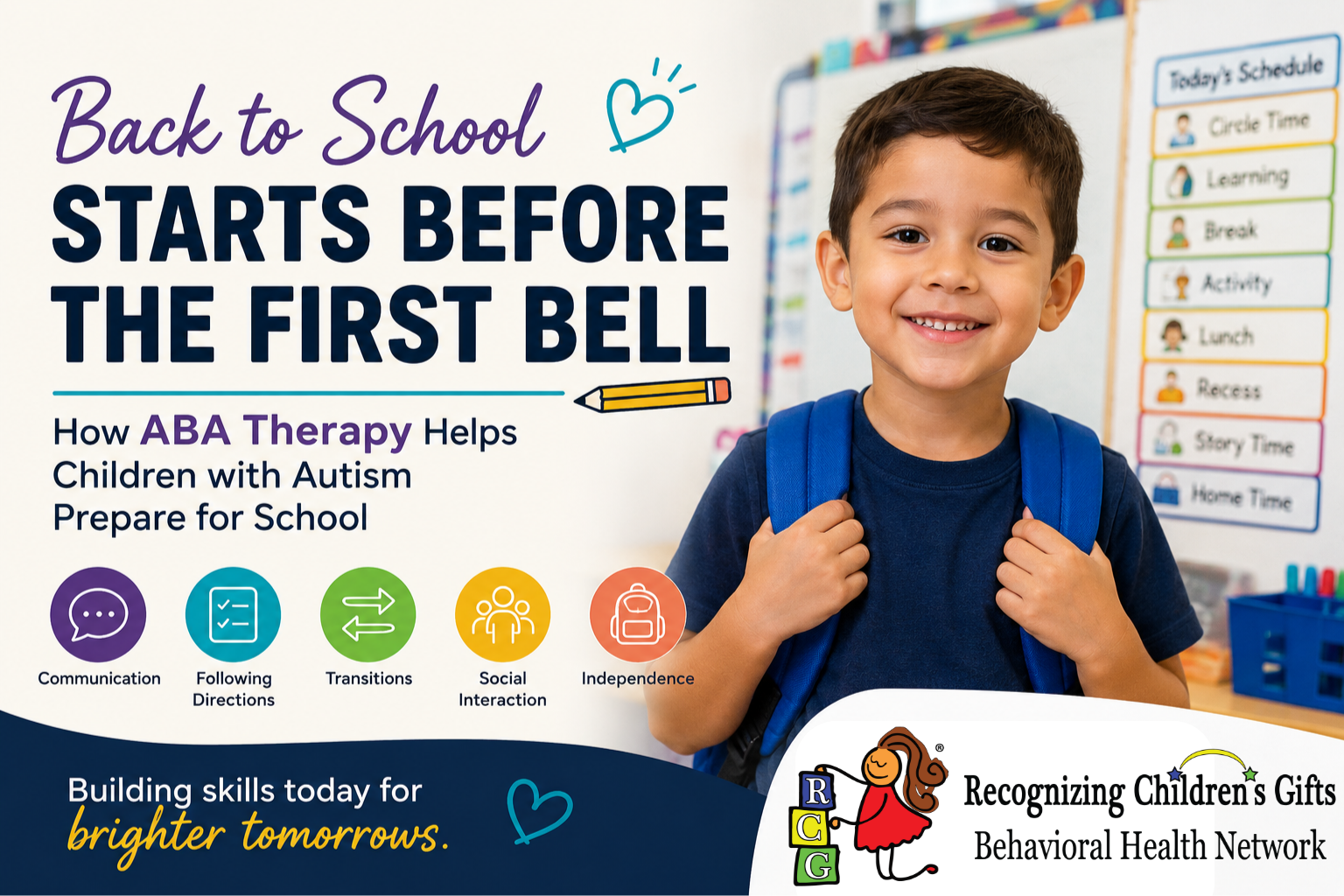
For children with autism, preparing for school involves much more than academics. School readiness includes communication, social interaction, following directions, managing transitions, and developing independence.
Applied Behavior Analysis (ABA) therapy can help children build these foundational skills before the first bell rings.
At RCG Behavioral Health Network, we work with children and families to develop practical skills that support success at school, at home, and in the community.
Why Back-to-School Transitions Can Be Challenging for Children with Autism
A new school year brings significant change.
Children may encounter a new teacher, classroom, schedule, classmates, expectations, and sensory environment—all at the same time.
For some children with autism, these changes can make the transition back to school especially challenging. A child who was successful during the previous school year may still need time and support to adjust after summer break.
Challenges may include:
- Difficulty transitioning between activities
- Communication frustration
- Sensory overload
- Difficulty following new routines
- Increased anxiety
- Emotional dysregulation
- Difficulty participating in group activities
Preparing for these changes ahead of time can help children become more familiar with the skills and routines they will use throughout the school day.
School Readiness Is More Than Academics
Knowing letters, numbers, colors, and shapes can be important, but academic knowledge is only one part of being ready for school.
Consider the everyday demands of a classroom.
- Can a child ask for help?
- Can they follow a simple direction?
- Can they move from one activity to another?
- Can they wait for a turn?
- Can they communicate when they need a break?
- Can they participate in a group activity?
- Can they complete simple routines with increasing independence?
These foundational skills affect a child's ability to participate in learning throughout the entire school day.
That is why ABA therapy for school readiness often focuses on functional communication, behavior, social interaction, transitions, and independence in addition to traditional learning skills.
5 Important School Readiness Skills for Children with Autism
1. Communication
Communication is one of the most important skills a child brings into the classroom.
Communication does not always mean spoken language. Children may communicate using words, gestures, sign language, pictures, or Augmentative and Alternative Communication (AAC) devices.
The goal is for children to have an effective way to communicate needs such as:
- “I need help.”
- “I need a break.”
- “I’m finished.”
- “I don’t understand.”
Being able to communicate effectively can reduce frustration and help children participate more independently at school.
2. Following Directions
Children receive directions throughout the school day, such as “Line up,” “Come to the carpet,” “Clean up,” or “Get your backpack.”
Practicing one-step and, when appropriate, multi-step directions can help children become more comfortable participating in classroom routines.
ABA therapy can help teach these skills through individualized instruction, repetition, prompting, and positive reinforcement.
3. Transitioning Between Activities
Transitions can be difficult for many children with autism.
Throughout a typical school day, children may move from play to instruction, classroom to lunch, lunch to recess, or one activity to another.
ABA therapists may use strategies such as:
- Visual schedules
- First-Then boards
- Timers
- Countdown strategies
- Predictable routines
- Positive reinforcement
These tools can help children understand what is happening next and become more comfortable moving between activities.
4. Social Interaction
School provides many opportunities for children to interact with their peers.
Depending on the child's individual needs and developmental level, important social skills may include:
- Taking turns
- Sharing
- Greeting others
- Playing cooperatively
- Asking to join an activity
- Understanding personal space
- Participating in conversations
Social skills often require intentional teaching and opportunities to practice.
5. Independence
Developing independence can make a significant difference in a child's school experience.
Children may benefit from practicing skills such as washing their hands, managing their backpack, opening lunch containers, cleaning up materials, following familiar routines, and appropriately requesting assistance.
Even small gains in independence can help children participate more successfully in everyday classroom activities.
How ABA Therapy Can Help Prepare a Child for School
Applied Behavior Analysis is individualized to each child's needs.
Rather than expecting every child to learn the same skills in the same way, clinicians identify meaningful goals based on the child's current abilities and areas where additional support may be beneficial.
School-readiness goals may include:
- Improving functional communication
- Following classroom routines
- Increasing attention and participation
- Developing play and social skills
- Learning to wait
- Managing transitions
- Completing tasks more independently
- Developing emotional regulation skills
- Strengthening self-help skills
- Reducing behaviors that interfere with learning
An important goal is not simply reducing challenging behaviors. ABA therapy also focuses on teaching functional skills that give children more effective ways to communicate, participate, and navigate their environment.
How Parents Can Practice School Readiness at Home
Families can reinforce school-readiness skills through everyday activities. You do not need to turn your home into a classroom. Small, consistent opportunities can help.
Practice the morning routine. Begin following the same wake-up, dressing, breakfast, and preparation schedule your child will use during the school year.
Practice simple directions. Everyday instructions such as “put your shoes on,” “come to the table,” or “put this away” provide natural opportunities to practice listening and following directions.
Read together. Reading can support language, vocabulary, attention, and shared interaction.
Encourage independence. Allow your child opportunities to complete age-appropriate tasks independently before immediately stepping in to help.
Practice transitions. Timers, visual schedules, and simple countdowns can help children understand when one activity is ending and another is beginning.
The goal is consistency, not perfection.
A Collaborative Approach to School Readiness
Children often make the greatest progress when families, clinicians, educators, and other providers are working toward consistent goals.
At RCG Behavioral Health Network, our services include:
- Applied Behavior Analysis (ABA) Therapy
- School Prep Program
- Speech-Language Therapy
- Occupational Therapy
- Behavioral Assessments
- Autism Evaluations
- Social Skills Programming
- Family Education and Support
When appropriate and with family consent, collaboration can help children use skills learned in therapy across different environments.
Speech-language therapy can strengthen functional communication and social language, while occupational therapy may address skills related to independence, participation, and daily activities.
Together, these services can support the broader goal of helping each child develop meaningful skills for everyday life.
Preparing for School Starts Today
A successful transition to school does not begin on the first day of class.
It develops through the skills children build beforehand: communicating their needs, following routines, transitioning between activities, interacting with others, and becoming increasingly independent.
For children who need additional support, early and individualized intervention can provide more opportunities to develop and practice these skills.
At RCG Behavioral Health Network, we partner with families to help children build skills that support success not only in the classroom, but also at home and throughout their communities.
Frequently Asked Questions About ABA Therapy and School Readiness
How does ABA therapy prepare children with autism for school?
ABA therapy can help children develop foundational skills needed in classroom environments, including communication, following directions, transitioning between activities, social interaction, attention, emotional regulation, and independence. Goals are individualized based on each child's needs.
When should I begin preparing my child for school?
School readiness can be practiced throughout the year rather than only during the weeks immediately before school begins. Consistent opportunities to practice communication, routines, transitions, and independence can help children become more familiar with skills they may use at school.
What if my child does not use spoken language?
Spoken language is not the only form of communication. Depending on individual needs, children may communicate through gestures, sign language, picture-based systems, or Augmentative and Alternative Communication (AAC) devices. The goal is to help each child develop an effective way to communicate their wants and needs.
Does RCG collaborate with schools and other providers?
When appropriate and with family consent, RCG clinicians may collaborate with families, educators, and other providers to promote consistency and support meaningful progress across environments.
Help Your Child Prepare for School and Beyond
Every child's path is different. The right support should reflect your child's individual strengths, needs, and goals.
If you are looking for ABA therapy, autism services, or school-readiness support in Central Virginia, RCG Behavioral Health Network is here to help.